New Sail Drive now fitted.
Mike, the Volvo engineer unexpectantly turned up early and before I had chance to clean the engine room, see my previous blog, Mike had already done the clean, fitted the new sail drive and the engine, together with refitting the companionway stairs. It looks like he has made an excellent and thoroughly professional job. I would certainly recommend him to other boat owners.
I’d forgotten to leave the engine oil and coolant, so Mike was unable to service the engine, which he is now planning for another day. I have also asked him to look at the under floor diesel tank changeover lever as this seems to be getting very stiff.
When I delivered the sail drive to the boat a couple of weeks ago, it was reasonably easy to do without assistance, BUT, at that time the boat was in the water, so I only had to lift its bulky 40-50kg weight from the pontoon trolly to the boat deck , which is about 2 feet (60cm) above the trolly. However, the old sail drive is now boxed up on deck which is about 16 feet (4.8mtrs) down to yard floor. I didn’t really want to leave it on deck for the next few weeks, neither did I rate my chances of successfully taking it down a ladder on my own…. or with help. And to make life a bit more difficult it was dark.
So, I had a cup of coffee and pondered a solution. I decided to try using the yacht boom with the rescue hoist (this is a pully and rope system designed to lift an injured “man overboard” casualty form the water) as a crane. I’d never done this before and it was a another learning curve. After positioning the boom and securing it to the bow mooring cleat with a mooring line and tying a secure lifting rope around the sail drive box, all in the dark, I rigged the boom with the rescue hoist and was well impressed how easy and successful it was, until I ran out of hoist line leaving the sail drive suspended about 5 feet (1.5mtrs) off the yard floor, see photo below. I tried to take its weight and unclip it, but at that height it was impossible and I was going to drop or damage it, or worse, hurt myself. I hauled it back up to the deck using the hoist, leaving it there to think about a solution overnight. Again, I was surprised how easy the hoist made this process.
Overnight I decided to make up a second hoist attached to the bottom of the rescue hoist, using a climbing rope and carabiners I have on board with my solo mast climbing gear. (Last year, I decided I would likely have to solo climb the mast at some point, so employed a specialist climber to teach me the required climbing skills and to specify what climbing gear was needed). I copied the ropework of the rescue hoist using the carabiners as pully blocks. I set it all up and lowered the sail drive down using the rescue hoist first, then when that reached its limit, used my make shift hoist to lower the sail drive down to the floor.
I was chuffed to bits how successful it was !
Finally, I decided the ladder access via the beam of the boat was unnecessarily dangerous as the top of the ladder stopped at deck level and there was no real safety grab point at the top. Mounting and dismounting the ladder from the deck felt like a leap of faith! Also the life lines (2 horizonal steel wires around the entire boat, that act as a fall guard rail between the deck and water) I had dismantled to prevent the crane strop (lifting strap) damaging them when the boat was hauled out of the water last week. I reassembled the life wires and moved the ladder for safer access via the boats small stern (rear) swim platform. It now feels much safer as does walking around the deck so high up.
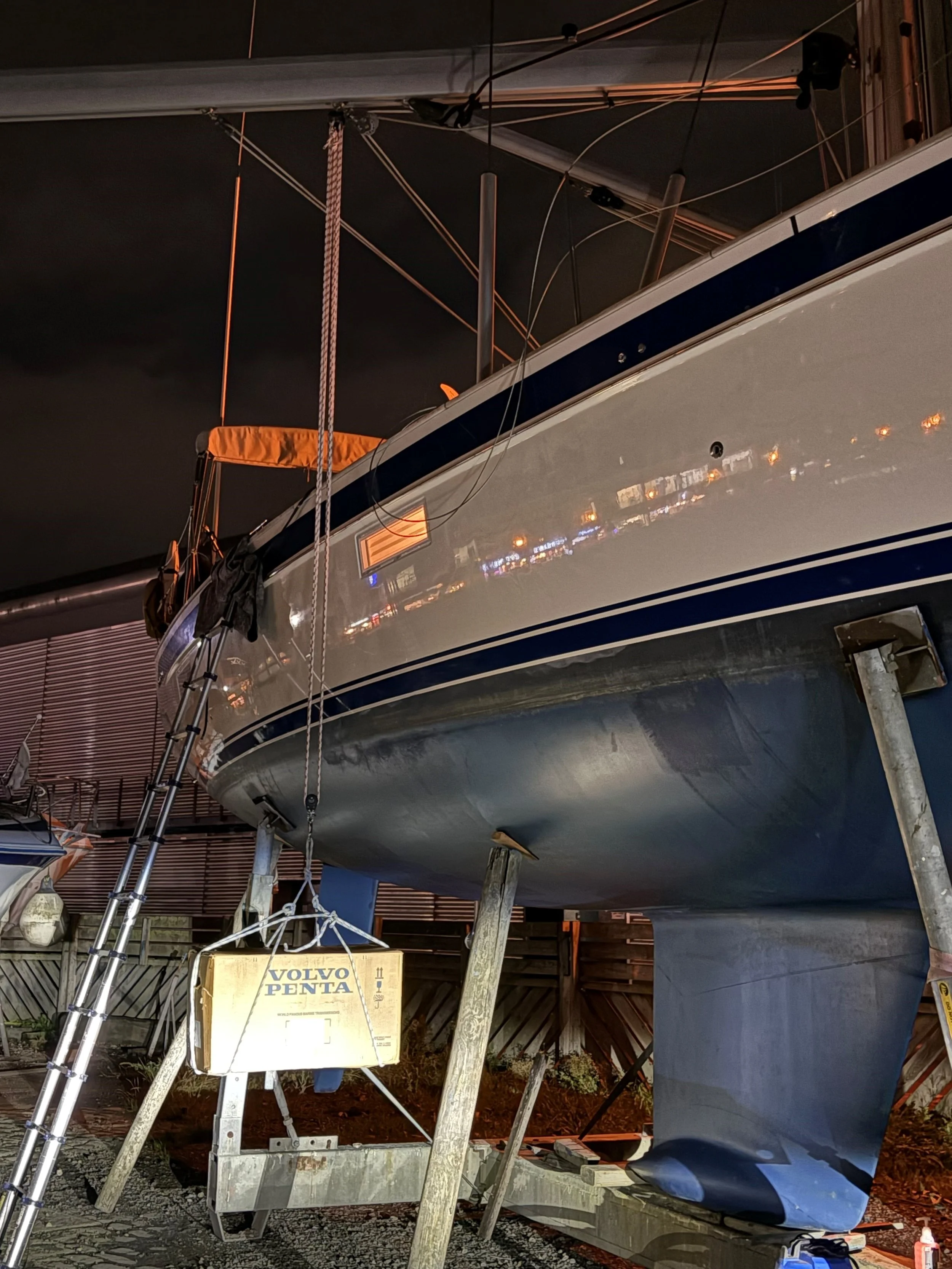
Boom rescue hoist set up lowering sail drive and coming up short.
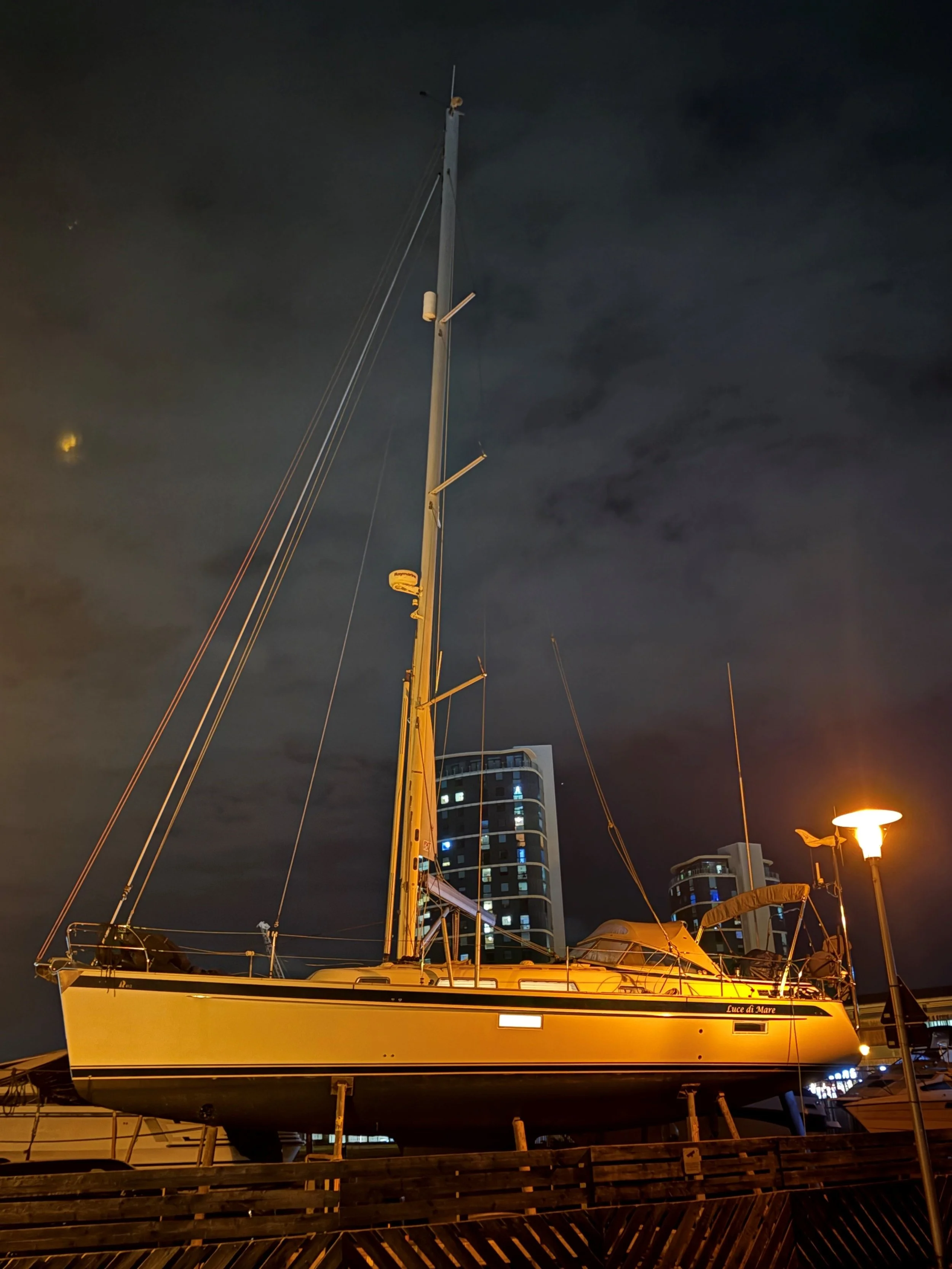
Luce Di Mare in Chatham yard at night. I just thought it was a nice picture !